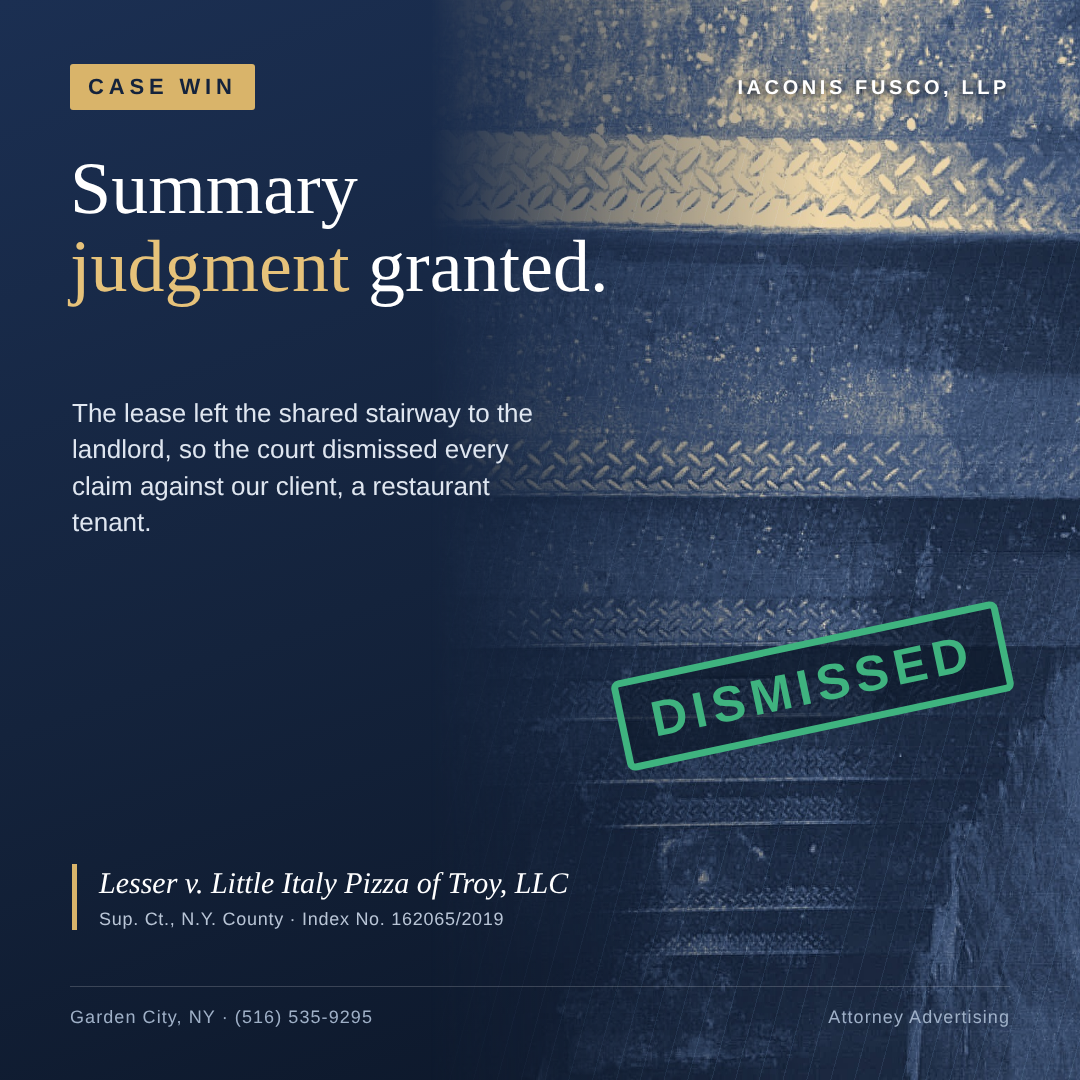
Iaconis Fusco, LLP obtained summary judgment dismissing the complaint and every cross-claim against its clients, Taim Flatiron LLC and Taim Restaurant Holdings LLC, in Lesser v. Little Italy Pizza of Troy, LLC, Index No. 162065/2019. Justice Arlene P. Bluth of the Supreme Court, New York County, issued the decision on August 6, 2026.
The court held that a restaurant tenant owed no duty for a shared basement staircase that its lease excluded from the leased premises. It also rejected the argument that the tenant's storage of used cooking oil in the basement created a question of fact about the cause of the fall.
The plaintiff, a delivery worker, alleged that he fell at about 5:30 a.m. on June 14, 2019, while making a delivery to Taim's basement storage room at 64 West 22nd Street in Manhattan. The basement is reached through a sidewalk-level door that opens onto a staircase. Several ground-floor restaurants rented basement storage rooms, and the basement also held utility meters and garbage.
The plaintiff testified that it had rained the night before, the street door was open, and his foot hit a slippery substance on the second step down.
The landlord, Francmen 688 LLC, argued that the tenants were jointly responsible for maintaining the communal staircase. The plaintiff argued that every defendant had a duty to inspect the steps and had constructive notice of the condition. Both pointed to Taim's admission that it stored drums of used cooking oil in the basement as evidence that Taim created the hazard.
The court observed that the parties opposing dismissal focused on deposition testimony about who witnesses believed was responsible for the stairs, while saying little about the lease itself. The lease answered the question:
It defined the premises as the ground-floor store and a designated basement storage room, nothing more.
It expressly excluded stairways and other shared building facilities from the premises, and reserved to the landlord the use of those areas and access for "operation, maintenance, alteration and repair."
Its rules and regulations required tenants not to obstruct stairways, but reserved to the landlord control of the building's public and common-use areas.
Because Taim's lease contained the same provisions as its co-tenant's, the court held that the staircase was not part of Taim's premises and that maintenance of the stairs remained with the landlord.
The court found no evidence that any oil was spilled or that oil caused the fall. The plaintiff's own testimony established that the street door was open after a night of rain. Rainwater on uncleaned stairs facing a busy Manhattan street was enough to explain a slippery condition, and the record did not link the stored oil to the steps on the day of the accident.
For commercial tenants and their carriers: Start with the lease's definition of "premises" and its list of excluded areas. When a lease leaves shared stairways and common areas outside the premises and reserves their control to the landlord, a tenant can defeat a premises-liability claim as a matter of law, even when the injured person was coming to the tenant's space.
For landlords: If you expect tenants to clean or maintain a shared staircase or entryway, the lease must say so expressly. A witness's understanding of who handles cleaning will not override lease language that reserves those areas to the landlord.
For defense counsel: A tenant's activity near the accident site, such as storing oil, does not create an issue of fact without evidence connecting it to the condition that caused the fall. Pressing the opposing parties to tie the theory to the record, and anchoring the motion in the lease, carried the day here.
